
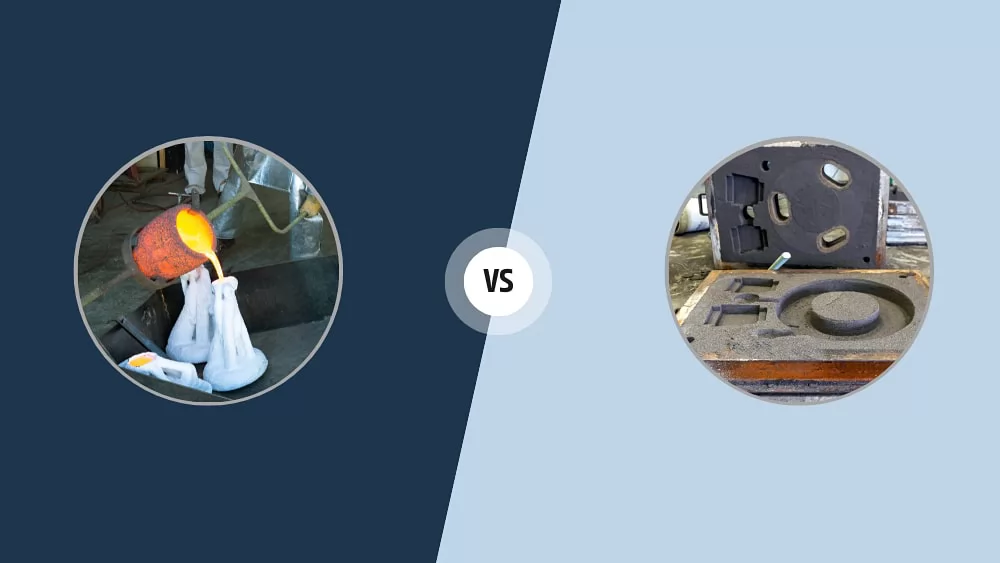
Lost Foam Casting and sand casting — which is better? The answer depends on your project goals and production requirements. You've got a part to make. Someone on your team says lost foam casting, someone else says sand casting — and both of them sound convincing. The truth is, there's no universally "better" process. There's only the one that fits your part, your volume, and your budget. This guide cuts through the noise and helps you figure out which one that is.
Table of Contents
- What Is Lost Foam Casting?
- What Is Sand Casting?
- Lost Foam Casting — Pros & Cons
- Sand Casting — Pros & Cons
- Key Differences Between Lost Foam Casting and Sand Casting
- Key Factors to Consider Before You Decide
- Which Process Should You Choose?
- FAQ — Questions People Actually Ask
- Conclusion
What Is Lost Foam Casting?
Lost foam casting is a metal casting process where a foam replica of your part is buried in dry sand and molten metal is poured directly onto it. The foam vaporizes instantly on contact, and the metal fills the exact space it left behind. No mold to open, no pattern to pull out — what you designed in foam is what you get in metal. It's also called evaporative pattern casting (EPC) or expanded polystyrene casting, depending on who you're talking to.
What Is Sand Casting?
Sand casting is the most widely used metal casting process in the world. A solid pattern — usually wood or metal — is pressed into a sand mixture to create a mold cavity. The pattern is removed, the two halves of the mold are closed, and molten metal is poured in. Once it cools, you break the mold apart and pull out the part. It's flexible, works with almost any metal, and has low tooling costs — which is why it's been the default choice for custom and low-volume work for decades.
Lost Foam Casting — Pros & Cons
✅ Pros
-
No parting lines or flash
The foam pattern is one piece, so there's nothing to split apart. You get a cleaner surface straight out of the mold — less grinding, less cleanup. -
Complex geometry without cores
Internal channels, curved passages, enclosed cavities — all built into the foam pattern. No separate cores to assemble, no risk of them shifting during the pour. -
Less post-machining
Tighter tolerances and smoother surfaces mean you can often skip steps that sand casting would require. For high-volume runs, that's a significant cost saving. -
Sand is almost fully reusable
Dry, unbonded sand — no chemical binders. Around 98% of it gets recycled back into the process, which keeps material costs down and waste low. -
Scales well for mass production
Once tooling is done, the process is consistent and easy to automate. Cycle times are predictable, which makes scheduling and costing more reliable. -
Design freedom
No draft angle requirements because the pattern doesn't need to be pulled out. That gives engineers more flexibility, especially on vertical walls and tight internal features.
⚠️ Cons
-
High upfront tooling cost
The aluminum foam dies aren't cheap. If your volumes don't justify the investment, you'll never recoup that cost — and it's a sunk cost if the design changes. -
Not great for low-volume or prototype work
Every foam pattern is single-use. At low volumes, the cost per part is high because tooling gets amortized across fewer pieces. -
Limited material compatibility
Works best with cast iron and aluminum. High-temperature metals like stainless steel are problematic — the vaporized foam can cause carbon pickup and surface defects. -
Design changes are expensive
Once the aluminum die is made, modifications cost money. If your part design is still evolving, you could end up paying for tooling twice. -
Longer lead time for first sample
Foam die fabrication takes time. Don't expect a first sample in days — you're typically looking at several weeks from order to first pour. -
Fume management required
When the foam vaporizes, it produces organic gases. Foundries need proper ventilation and emission controls in place — something smaller operations may not have set up.
Sand Casting — Pros & Cons
✅ Pros
-
Low upfront cost
A wood or resin pattern is all you need to get started. There's no expensive tooling commitment, which makes it easy to justify for small orders or first-time projects. -
Works with almost any metal
Steel, stainless, aluminum, copper alloys, high-temp alloys — sand casting handles the full range. It's the most versatile casting process in terms of material compatibility. -
Fast turnaround for prototypes
Patterns can be made in days. If you need parts quickly or you're still in the validation stage, sand casting gets you there without a long wait. -
Easy to modify
Design changed? Sand patterns can be reworked or remade quickly and cheaply. There's no locked-in aluminum die to worry about. -
Handles large and heavy parts well
Machine bases, heavy equipment housings, large structural components — sand casting doesn't have the size limitations that more specialized processes do. -
Widely available
Sand casting foundries are everywhere. You have more supplier options, easier sourcing, and less dependency on specialized equipment or expertise.
⚠️ Cons
-
Rougher surface finish
Sand molds leave a textured surface on the casting. Most parts need grinding, shot blasting, or machining before they're ready to use — adding time and cost. -
Parting lines and flash
Because the mold splits in two, there's always a seam where the halves meet. That flash has to be removed, which adds a manual step to every part. -
Complex internal shapes require cores
Internal channels and cavities need separate sand cores, which have to be made, positioned, and held in place during the pour. Cores can shift, break, or cause dimensional problems. -
Higher per-unit cost at volume
The process is labor-intensive — molding, coring, closing, shaking out. Those steps don't automate as easily, so per-unit cost stays relatively flat even as volumes increase. -
More post-machining
Lower dimensional accuracy means more surfaces need to be machined to final spec. If you're outsourcing that machining, it adds lead time and cost on top of the casting itself. -
Sand waste and dust
Sand casting generates dust during mixing, pouring, and shakeout. It's manageable, but it does require dust collection systems and regular sand maintenance.
Key Differences Between Lost Foam Casting and Sand Casting
Most articles list process parameters. What you probably want to know is: how does this affect my part, my timeline, and my cost? Here's the same comparison, framed differently.
| Your concern | Lost Foam Casting | Sand Casting |
|---|---|---|
| Will I need a lot of machining after casting? | Usually not. No parting lines, cleaner surface — often 30–50% less post-machining | Likely yes. Parting lines and core marks usually need cleaning up |
| Can it handle my complex internal shape? | Yes — no separate cores needed, the foam pattern handles everything in one piece | Depends. Complex internal channels require separate sand cores, which can shift or cause defects |
| How much does it cost to get started? | Higher upfront — aluminum foam dies aren't cheap | Low — a wood or resin pattern is enough to get going |
| What happens to cost as my volume grows? | Gets cheaper per piece — process is easy to automate, consistent cycle times | Stays relatively flat — labor-intensive steps don't scale as well |
| How fast can I get a first sample? | Slower — foam die tooling takes time | Faster — pattern can be ready in days |
| What if I need to change the design later? | Costly — the aluminum die is fixed, changes mean new tooling | Easy — sand patterns can be modified quickly and cheaply |
| What metals can I use? | Cast iron and aluminum work best; high-temp steels are tricky | Almost anything — steel, stainless, copper alloys, you name it |
| Will the surface be good enough to skip grinding? | Often yes — Ra 6.3–12.5 μm is clean enough for many non-critical surfaces | Usually not — surface is rougher and typically needs finishing work |
| I'm ordering 50 pieces. Which makes sense? | Probably not — tooling cost won't pay off at that volume | Yes — low upfront cost, no minimum volume pressure |
| I'm ordering 20,000 pieces a year. Which makes sense? | Yes — this is where lost foam really earns its keep | Possible, but per-unit cost and machining bills will be higher |
The short version: if your part is complex, your volumes are high, and you want to minimize machining — lost foam is worth the tooling investment. If you're still figuring out the design, running small quantities, or working with steel — sand casting is the more practical starting point.
Key Factors to Consider Before You Decide
Before jumping to "which one is better," it's worth stepping back and thinking through what actually matters for your specific situation. These are the factors that tend to make or break the decision:
Production Volume
This is usually the first filter. Lost foam tooling costs are real — if you're ordering a few hundred pieces, you'll likely never recover that upfront investment. As a rough rule, lost foam starts making economic sense somewhere around 3,000–5,000 pieces per year and up. Below that, sand casting almost always wins on cost.
Part Complexity
How many internal channels, undercuts, or cavities does your part have? If the answer is "a lot," lost foam is worth seriously considering — you can build all of that complexity into a single foam pattern instead of assembling multiple sand cores. The more complex the part, the more lost foam's advantages compound.
Dimensional Tolerance Requirements
How tight do your tolerances need to be? If your drawing has tight fits, precise bore locations, or surfaces that mate with other parts, lost foam's CT7–CT9 accuracy may save you significant machining time. If your part is structural and tolerances are loose, sand casting's lower accuracy is often perfectly acceptable.
How Much Post-Machining Can You Absorb?
Sand casting parts typically come out rougher and need more cleanup — grinding, milling, boring. If you have machining capacity in-house and the cost is predictable, that might be fine. But if you're outsourcing machining or trying to keep lead times short, the extra steps add up quickly. Lost foam's cleaner output can meaningfully simplify your downstream process.
Material
Lost foam works best with cast iron and aluminum alloys. If your spec calls for stainless steel, heat-resistant alloys, or anything with a very high melting point, sand casting is the more reliable choice — the chemistry is simpler and defect risk is lower. Don't try to force a material into the wrong process.
Design Stability
Is your design locked, or is it still evolving? Lost foam requires an aluminum foam die — once it's made, changes are expensive. Sand casting patterns can be modified in days at low cost. If you're still iterating, stay in sand casting until the geometry is frozen. Switching to lost foam with an unstable design is a common and costly mistake.
Lead Time for First Sample
Lost foam tooling takes time — expect several weeks before you see a first sample. Sand casting can turn around a prototype in days. If you're under schedule pressure or need to qualify a part quickly, sand casting gets you there faster. Lost foam is a better fit when you're in stable, planned production.
Which Process Should You Choose?
Choose Lost Foam Casting if…
- Your part has complex internal channels or cavities. Think pump housings, engine blocks, valve bodies — anything where you'd normally need multiple sand cores. Lost foam integrates all of that into one foam pattern. No core assembly, no risk of cores shifting during the pour.
- You're tired of machining bills. No parting lines and a cleaner surface means you can cut secondary machining by 30–50% depending on geometry. For high-volume runs, that difference adds up fast.
- You're running tens of thousands of parts per year. The upfront tooling cost for foam dies is real — don't ignore it. But once that's covered, the per-unit cost drops significantly because the process automates well and cycle times are consistent.
- Your material is cast iron or aluminum. Aluminum in particular pours cleanly with EPS foam and produces accurate castings. High-temperature steels are trickier — vaporized foam can leave carbon residue that causes surface defects.
Choose Sand Casting if…
- You need a prototype or a small batch. Sand casting patterns are cheap — wood works fine. If you need 20 pieces or you're still validating the design, lost foam's tooling cost simply doesn't make sense yet.
- Your part is large and structurally simple. Big machine bases, equipment housings, heavy covers — sand casting handles large volumes of metal without special pattern requirements.
- You're working with steel or special alloys. Sand casting handles nearly every engineering metal. If your spec calls for stainless, heat-resistant alloy, or anything with a high melting point, sand casting is the safer route.
- Your design is still changing. Sand patterns can be modified quickly. With lost foam, the aluminum die is fixed — design changes cost money. Stay in sand casting until the geometry is locked.
- You need parts fast. Pattern lead time for sand casting is days, not weeks. If you're under time pressure and volumes are low, sand casting gets you parts sooner.
FAQ — Questions People Actually Ask
Is lost foam casting more expensive than sand casting?
Upfront, yes. The foam dies cost more than a wood pattern. But per-unit at volume, lost foam usually wins because it needs less machining and less labor per cycle. The crossover point is typically somewhere around a few thousand pieces per year, depending on part complexity.
Can lost foam casting replace sand casting entirely?
No. Sand casting still handles a wider range of metals, larger parts, and low-volume work better. They're tools for different jobs. Most foundries that offer lost foam also keep sand casting lines running — because some projects just fit one better than the other.
What's the difference between lost foam and investment casting?
Both use a sacrificial pattern. Investment casting uses wax — it's melted out before the pour, which requires a bake-out step and more process control. Lost foam uses EPS foam that vaporizes when the metal hits it, skipping the bake-out entirely. Lost foam is generally more economical for mid-to-high volume work; investment casting achieves tighter tolerances for very small, intricate parts.
Does lost foam casting work for stainless steel?
It can, but it's difficult. At the high temperatures needed to pour stainless, the vaporized foam tends to cause carbon pickup and surface defects. Most foundries prefer sand casting or investment casting for stainless steel work.
What surface finish can I expect from lost foam casting?
Typically Ra 6.3–12.5 μm, with dimensional tolerances around ±0.005 mm/mm. That's meaningfully better than standard sand casting and often good enough to skip grinding on non-critical surfaces — which is a big deal if you're trying to reduce post-processing costs.
How does lost foam casting handle thin walls?
Reasonably well — minimum wall thickness is around 2.5 mm. Because the foam pattern doesn't need to be removed, you don't have the draft angle constraints that limit how thin you can go with sand casting. That said, very thin walls still require careful gating design to ensure the metal fills before it cools.
What is "evaporative pattern casting" — is it the same thing?
Yes, same process. Lost foam casting goes by several names: evaporative pattern casting (EPC), expanded polystyrene casting, and full-mold casting are all terms you'll see used interchangeably in different regions and industries.
Conclusion
Lost foam casting wins on precision, surface finish, and per-unit cost at volume — especially for complex parts in cast iron or aluminum. Sand casting wins on flexibility, upfront cost, and metal compatibility.
If your part is complex, your volumes are high, and your material is aluminum or iron — lost foam is worth the tooling investment. If you're still prototyping, running small batches, or working with steel — start with sand casting and revisit once volumes justify the switch.
Not sure which fits your project? Send us your drawing and we'll give you a straight answer.


