
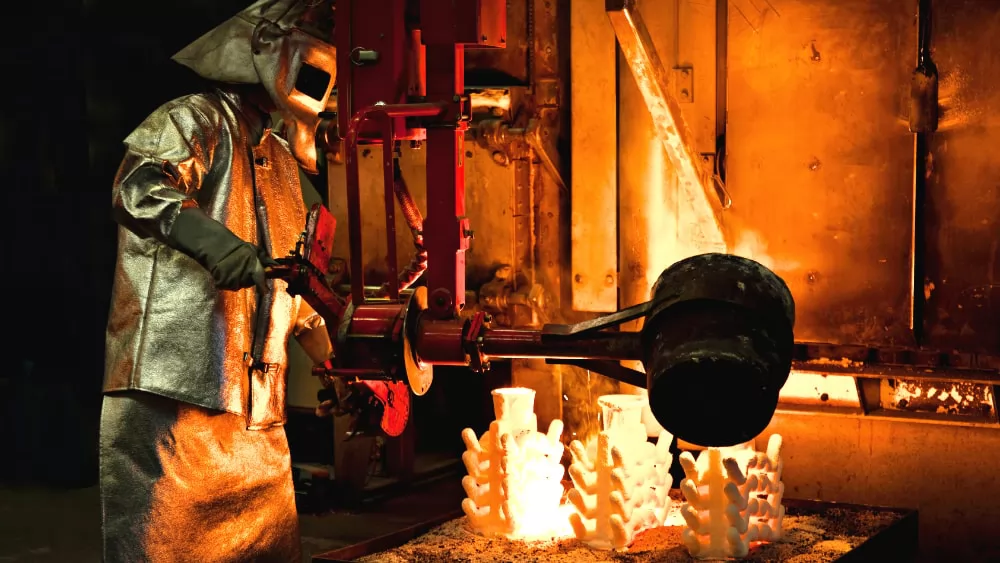
Metal manufacturing processes define how raw metal materials are transformed into functional parts and components used across industries such as automotive, construction, energy, and heavy equipment. From casting and forging to CNC machining and advanced manufacturing technologies, each metal manufacturing process offers distinct advantages in terms of strength, precision, cost, and production efficiency.
Understanding the differences between these processes is essential for engineers, buyers, and manufacturers seeking optimal performance, quality, and value in metal parts production.
What Are Metal Manufacturing Processes?
Metal manufacturing processes refer to the industrial methods used to shape, form, join, and finish metal materials into usable products or components. These processes begin with raw materials such as billets, ingots, sheets, or bars and involve mechanical, thermal, or chemical operations to achieve the desired geometry, mechanical properties, and surface quality. Common metal manufacturing processes include casting, forging, machining, welding, heat treatment, and surface finishing, each serving specific functional and production requirements.
Sand Casting
Sand casting is the oldest and most widely used casting method. This process uses molds made of specialized casting sand, often mixed with clay or other binders to maintain their shape. Sand molds can be either green (moist) or dry (baked and hardened). The process includes: first creating a pattern (usually wood or metal), pressing it into a sand box to form the mold cavity, removing the pattern to leave the cavity, then pouring molten metal. After cooling and solidification, the sand mold is broken to remove the casting. Its main advantages include low mold cost, ability to cast large parts (weighing several tons), suitability for almost all metal alloys, and high production flexibility. Drawbacks include rough surface finish, limited dimensional accuracy, relatively high labor intensity, and slower production speed.This process is widely used in engine blocks and cylinder heads for the automotive industry, machine bases and frames for heavy machinery, pipeline valves, gearboxes, and large components of various industrial equipment. For a detailed comparison, see Lost Foam Casting Vs. Sand Casting: How to Choose?.
When to Choose:
- Production Volume: Small to medium batch (1-10,000 pieces)
- Part Size: Large or extra-large parts (prioritize for parts weighing over 500 kg)
- Metal Type: High melting point metals (steel, cast iron), special alloys
- Development Cycle: Need quick mold making (1-4 weeks)
- Budget Constraints: Limited initial investment budget
Typical Applications: Engine blocks, valves, pump housings, machine tool bases
Investment Casting
Investment casting, also known as lost-wax casting, is a high-precision casting process. The steps include: first, making an accurate model from wax or plastic; assembling multiple wax patterns onto a sprue to form a "wax tree"; repeatedly dipping the wax tree in ceramic slurry and sprinkling refractory material to create a multi-layer ceramic shell; heating to melt out the wax, leaving a hollow ceramic mold; firing the ceramic shell at high temperature to enhance strength; pouring molten metal; after cooling, breaking the ceramic shell to extract the casting. Key advantages include extremely high dimensional accuracy and surface finish (little or no post-processing needed), ability to cast very complex shapes, production of thin-walled parts (wall thickness as low as 0.5 mm), and suitability for hard-to-machine materials. Main drawbacks are complex process, high mold cost, long production cycle, and size limitations. Applications include aerospace turbine blades and engine components, medical devices, jewelry, weapon parts, and golf club heads.
When to Choose:
- Geometric Complexity: Parts with complex internal cavities, fine details (minimum hole diameter 1mm)
- Material Characteristics: Difficult-to-machine materials (high-temperature alloys, titanium alloys)
- Accuracy Requirements: High precision (tolerance ±0.1-0.5mm/25mm)
- Production Volume: Small to medium batch (50-50,000 pieces)
- Industry Requirements: High-end applications in aerospace, medical devices, etc.
Typical Applications: Turbine blades, orthopedic implants, golf club heads
Die Casting
Die casting is a process where molten metal is injected under high pressure into steel molds. The process involves: preheating the mold and applying a release agent; pouring molten metal into the die chamber of the die casting machine; using a piston or plunger to inject the metal at high pressure (usually 10-200 MPa) into the mold cavity; rapid cooling and solidification under pressure; finally, opening the mold and ejecting the casting. Die casting is divided into hot-chamber (for low-melting alloys such as zinc and magnesium) and cold-chamber (for higher-melting alloys such as aluminum) processes. Key advantages include extremely high production efficiency (hundreds of pieces per hour), high dimensional accuracy, good surface quality, ability to produce thin-walled complex parts, and suitability for automated production. Drawbacks include very high mold cost, limited to non-ferrous metals, potential for porosity, and size constraints. Widely used in automotive transmission housings and engine parts, consumer electronics like smartphone casings and laptop frames, household hardware and locks, and toys and model manufacturing. For more insights, see Why Global Automakers Seek China's Investment Casting.
When to Choose:
- Production Volume: Mass production (>10,000 pieces, mold cost needs to be amortized)
- Part Characteristics: Thin-walled complex parts (wall thickness 1-3mm), requiring high precision fit
- Metal Limitations: Non-ferrous metals (aluminum, zinc, magnesium alloys)
- Production Takt Time: Require high-speed production (hundreds of pieces per hour)
- Post-processing Needs: Want to reduce or eliminate machining
Typical Applications: Automotive transmission housings, laptop computer casings, smart lock bodies
Permanent Mold Casting
Permanent mold casting uses reusable metal molds, typically made of cast iron or steel. The process involves: preheating the metal mold and applying a refractory coating; closing the mold and pouring molten metal; using gravity or low pressure to fill the mold cavity; accelerating solidification using the mold's own cooling or an external cooling system; finally, opening the mold to remove the casting. Key features include long mold life (thousands to tens of thousands of uses), fast cooling (leading to finer grain structure and improved mechanical properties), high dimensional consistency, and better surface finish than sand casting. Main limitations are high mold cost, suitable for relatively simple geometries, and typically limited to non-ferrous metals. Typical applications include automotive pistons, cylinder heads, wheel hubs, motor housings, pumps, and valve components.
When to Choose:
- Production Volume: Medium batch (1,000-100,000 pieces)
- Material Requirements: Primarily aluminum alloys, copper alloys
- Quality Requirements: Need good mechanical properties (better than sand castings)
- Cost Balance: Cost-effective choice between sand casting and die casting
- Production Environment: Want to reduce environmental pollution (no waste sand disposal)
Typical Applications: Automotive pistons, wheel hubs, motor housings
Centrifugal Casting
Centrifugal casting uses centrifugal force to distribute molten metal onto the inner surface of a rotating mold. Main types include true centrifugal casting (producing hollow cylindrical parts without cores), semi-centrifugal casting (using cores to produce complex shapes), and centrifuge casting (producing multiple castings on a rotating platform simultaneously). The process involves pouring molten metal into a high-speed rotating mold; centrifugal force ensures the metal adheres to the mold wall, forming uniform wall thickness; metal solidifies while rotating; finally, rotation stops and the casting is removed. Key advantages include high density (centrifugal force helps remove gas and impurities), uniform wall thickness, high metal utilization, and little or no gating system needed. Drawbacks are complex equipment, shape limitations (mainly axisymmetric parts), and inner surface quality is hard to control. Widely used in pipes and fittings, bushings and bearing rings, cylinder liners, and various cylindrical and ring-shaped components.
When to Choose:
- Part Shape: Rotationally symmetric parts (pipes, sleeves, bearing rings)
- Quality Requirements: Require high density, free from porosity defects
- Material Characteristics: Suitable for casting alloys with poor fluidity
- Production Type: Continuous production of same-specification products
- Size Range: Tubular parts with diameters from 50mm to 3m
Typical Applications: Oil pipelines, rollers, cylinder liners
Low-Pressure Casting
Low-pressure casting involves injecting molten metal into a mold from below under low pressure (typically 20-100 kPa). The process: place a sealed holding furnace below the mold, connect via a riser tube, apply low-pressure gas (dry air or inert gas) to the furnace, forcing the metal smoothly into the mold; maintain pressure until the casting solidifies; release pressure and return unsolidified metal to the furnace. Key advantages include smooth filling, reduced turbulence and oxidation, high metal utilization (simple gating), dense castings with minimal porosity, and automation capability. Drawbacks include high equipment investment, longer production cycles, and mold life affected by thermal fatigue. Especially suitable for high-quality large thin-walled parts such as automotive aluminum wheels (over 90% produced using this process), engine cylinder heads and blocks, motorcycle wheels, and other high-quality aluminum alloy castings.
When to Choose:
- Part Type: Large thin-walled aluminum alloy parts (such as wheels)
- Quality Requirements: Require high fatigue strength, low porosity
- Production Cost: Want to reduce gating system waste (metal utilization >90%)
- Automation Level: Suitable for automated production lines
- Batch Size: Medium to large batch (>5,000 pieces)
Typical Applications: Automotive aluminum wheels, engine cylinder heads
Lost Foam Casting
Lost foam casting uses expendable polystyrene (EPS) foam patterns. The process involves: first, making a foam model identical to the final part; coating the model with a refractory layer and drying; placing the model in a sand box filled with unbonded dry sand and compacting; directly pouring molten metal, which vaporizes the foam and fills the cavity; after cooling, remove the casting. Advantages include no need for parting lines or draft angles, very high design freedom, ability to produce complex internal cavities without cores, reduced machining allowance, improved material utilization, and environmentally friendly (no traditional sand handling). Drawbacks are high foam model cost, deformation risk for large parts, and fumes during pouring requiring treatment. Suitable for complex parts such as engine intake manifolds, machine tool beds, pump housings, artistic sculptures, and mass-produced automotive components.
When to Choose:
- Design Complexity: Parts with complex internal cavities, difficult to split for molding
- Production Volume: Small to medium batch (suitable for 50-5,000 pieces)
- Mold Cost: Want to reduce mold cost (foam patterns are low-cost)
- Production Environmental Protection: Want to reduce waste sand emissions
- Development Cycle: Quick prototype making
Typical Applications: Engine intake manifolds, machine tool beds, artistic castings
Continuous Casting
Continuous casting is a process where molten metal is continuously poured and solidified through a cooling system into semi-finished products with a fixed cross-section. The process: molten metal flows from the holding furnace into a tundish, then into a water-cooled crystallizer (mold); metal surface begins solidifying to form a shell; the strand is withdrawn from the mold into secondary cooling zones for complete solidification; finally, cut to required lengths. Forms include vertical, vertical-bend, curved, and horizontal continuous casting. Advantages include very high production efficiency, high material utilization (no risers), uniform cast quality (dense microstructure, minimal segregation), ease of automation, and low production cost. Drawbacks include high initial investment and suitability only for simple cross-section shapes. It is one of the most important processes in modern steelmaking, producing steel billets (for rolling into profiles, sheets, wires), aluminum ingots, copper rods, and special-section profiles.
When to Choose:
- Product Form: Need to produce billets for rods, plates, profiles
- Production Scale: Large-scale continuous production
- Material Type: Basic metals like steel, aluminum, copper
- Subsequent Processing: Provide billets for rolling, forging
- Quality Requirements: Require uniform metallographic structure
Typical Applications: Steel billets, aluminum ingots, copper rods
How to Choose Metal Casting Processes for Different Projects?
How to choose the right metal casting process for your project? Here's a practical guide to help you navigate the options and make the best choice for your specific application.
| Selection Dimension | Preferred Process | Alternative Process | Key Considerations | Reason |
|---|---|---|---|---|
| Different Industry Applications | Aerospace | Investment Casting | Permanent Mold Casting | High-temperature alloys, complex structures, high precision |
| Automotive Manufacturing | Die Casting | Low-Pressure Casting | Mass production, lightweight, cost control | |
| Medical Devices | Investment Casting | Die Casting | Biocompatibility, high precision, surface quality | |
| Construction Hardware | Sand Casting | Permanent Mold Casting | Cost priority, medium batch, simple structure | |
| Electronic Equipment | Die Casting | Investment Casting | Thin-walled complexity, high thermal conductivity, electromagnetic shielding | |
| Energy Equipment | Centrifugal Casting | Sand Casting | High temperature and pressure resistance, large-size pipe fittings | |
| Different Production Volumes | Prototype/Trial Production (1-50 pieces) | Sand Casting | Lost Foam Casting | Low mold cost, fast delivery |
| Small Batch (50-5,000 pieces) | Permanent Mold Casting | Investment Casting | Cost-performance balance, stable quality | |
| Medium Batch (5,000-50,000 pieces) | Low-Pressure Casting | Die Casting | Automation level, production efficiency | |
| Large Batch (50,000-500,000 pieces) | Die Casting | Continuous Casting | Lowest unit cost, high-speed production | |
| Ultra-Large Batch (>500,000 pieces) | Continuous Casting | Die Casting (multi-cavity mold) | Maximum efficiency, stable supply chain | |
| Different Budget Levels | Very Low Budget (<50,000 RMB) | Sand Casting | - | Lowest mold cost, suitable for simple parts |
| Low Budget (50,000-200,000 RMB) | Lost Foam Casting | Permanent Mold Casting | Good cost-performance, can handle complex parts | |
| Medium Budget (200,000-1,000,000 RMB) | Low-Pressure Casting | Investment Casting | Quality improvement, more stable process | |
| High Budget (1,000,000-5,000,000 RMB) | Die Casting | Centrifugal Casting | High efficiency, high precision equipment investment | |
| Very High Budget (>5,000,000 RMB) | Continuous Casting Production Line | Automated Die Casting Line | Large-scale production, full automation | |
| Different Metal Materials | Aluminum Alloys | Die Casting | Low-Pressure Casting | Good fluidity, suitable for complex thin-walled parts |
| Cast Iron | Sand Casting | Centrifugal Casting | High melting point, large shrinkage rate | |
| Stainless Steel | Investment Casting | Sand Casting | Corrosion resistance, high precision requirements | |
| Copper Alloys | Permanent Mold Casting | Centrifugal Casting | Good thermal conductivity, wear resistance | |
| Magnesium Alloys | Die Casting | Permanent Mold Casting | Lightweight, flammable requiring special handling | |
| Different Accuracy Requirements | General Accuracy (±0.5mm and above) | Sand Casting | Lost Foam Casting | Cost priority, subsequent machining possible |
| Medium Accuracy (±0.1-0.5mm) | Permanent Mold Casting | Low-Pressure Casting | Stable quality, reduced machining allowance | |
| High Accuracy (±0.05-0.1mm) | Die Casting | Investment Casting | Near-net shape, reduced waste | |
| Ultra-High Accuracy (±0.05mm and below) | Investment Casting | Precision Die Casting | Aerospace, medical implants |
Additional Notes:
- Cross-Consideration: Actual selection requires comprehensive consideration of multiple factors including industry, production volume, budget, material, and accuracy requirements.
- Mixed Strategy: For complex products, different process combinations can be used (e.g., main body sand casting + key parts investment casting).
- Development Stage: Startups are recommended to begin with sand casting/lost foam casting and upgrade to die casting/continuous casting as they scale.
- Geographical Factors: Consider local supply chain maturity; for example, die casting is more concentrated in the Pearl River Delta region, while investment casting is more concentrated in the Yangtze River Delta region.
- Environmental Requirements: In areas with strict environmental regulations, prioritize low-pollution processes such as lost foam casting and permanent mold casting.
Conclusion
Choosing the optimal casting process is crucial for component performance, cost, and manufacturability. At Qianhao, our team of experienced manufacturing engineers possesses extensive practical experience across a wide range of casting technologies, including precision investment casting, general sand casting, and specialized lost-wax casting methods. With this wealth of experience, we can provide expert guidance to help you make informed decisions and answer all your technical and logistical questions. We welcome you to contact us via email!


