
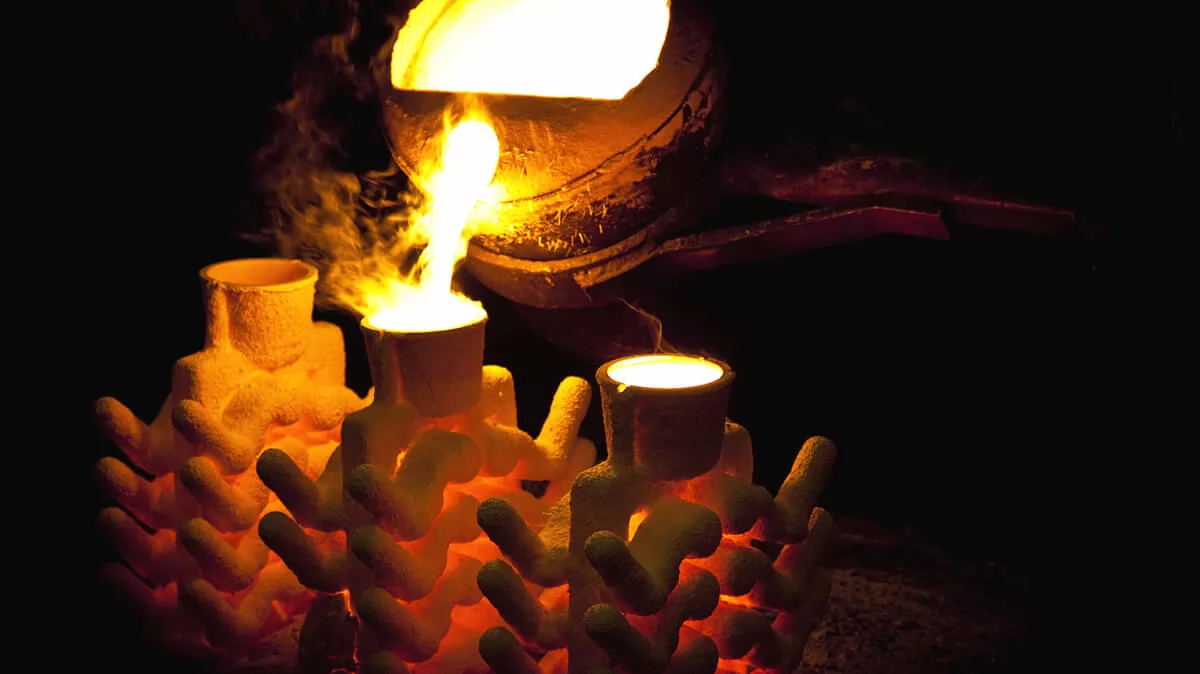
In high-end equipment, automotive, medical, aerospace, hydraulic, and valve industries, investment casting is almost always the preferred manufacturing process for metal parts that require high dimensional accuracy, surface finish, complex structures, and material strength. Why do so many companies prioritize investment casting? This is not accidental; it is determined by the core advantages of the process itself. Below, we will explain the main reasons.
1. High Dimensional Accuracy, Significantly Reducing Secondary Machining
One of the most notable advantages of investment casting is its high dimensional accuracy and stable tolerances. Compared with traditional sand casting, it allows manufacturers to achieve much tighter dimensional control during the casting process itself, typically reaching tolerance grades such as CT4–CT6. In addition, certain structural features like holes, steps, and base holes for threads can often be formed directly during casting. This greatly reduces the need for additional machining operations such as turning, milling, drilling, or grinding.
For manufacturers, machining is often one of the most time-consuming and expensive stages of production. By improving the precision of cast components, investment casting helps reduce machining steps, which can significantly lower overall production costs and shorten delivery times.
In summary, high precision is one of the most important advantages of investment casting. It allows complex structures to be produced while minimizing machining requirements. This makes the process particularly suitable for industries that demand high dimensional accuracy, such as machinery manufacturing, automation equipment production, and precision engineering.
2. Excellent Surface Finish, Ready for Assembly or Polishing
Castings produced through traditional sand casting typically have relatively rough surfaces and therefore require additional finishing processes such as grinding, sandblasting, or machining. Investment casting, however, uses precision wax patterns and ceramic shells to create a much smoother and finer surface finish. The resulting castings generally have high surface quality with minimal burrs, fewer defects, and almost no visible parting lines.
Because of this improved surface quality, many investment cast parts only require minimal finishing before undergoing further treatments such as electroplating, polishing, anodizing, or coating. You can learn more about suitable materials for lost-wax casting here.
From a manufacturing perspective, better surface quality not only reduces post-processing work but also improves the overall appearance and functional performance of the product. As a result, investment casting is widely used in industries that demand high surface standards, including medical equipment manufacturing, valve and fluid control systems, automotive components, and high-end consumer products.
3. Ability to Produce Extremely Complex Structures
Modern industrial products often require parts with highly complex geometries, such as internal channels, multi-hole structures, irregular surfaces, or multi-level shapes. If these parts are manufactured through conventional machining, the process can be extremely time-consuming and expensive. Forging or stamping processes may also struggle to achieve complex internal geometries. You can explore similar applications in shell casting processes.
Investment casting offers a solution by allowing complex shapes to be formed directly through precision wax patterns. Internal cavities, curved surfaces, and intricate structures can be produced in a single casting process. In many cases, multiple components can also be integrated into a single part, reducing the need for welding or assembly.
From a design and manufacturing perspective, complex geometry is one of the areas where investment casting truly excels. For industries such as aerospace equipment manufacturing, energy systems, and advanced mechanical engineering, this process enables greater design flexibility while maintaining structural strength and reliability.
4. Wide Range of Materials to Meet High-Performance Requirements
Investment casting is compatible with a wide range of industrial metals. Common materials include carbon steel, alloy steel, stainless steel, and various high-performance alloys. Stainless steels such as 304, 316, and duplex stainless steel 2205 are commonly produced using this process. In addition, high-temperature alloys, titanium alloys, aluminum alloys, and copper alloys can also be manufactured through investment casting.
This flexibility allows manufacturers to meet different performance requirements such as corrosion resistance, high-temperature resistance, high strength, or wear resistance.
Overall, the wide range of compatible materials is another major advantage of investment casting. It enables the process to serve diverse industrial applications. Industries such as petrochemical equipment manufacturing, marine engineering, and high-temperature industrial equipment production often rely on this process to achieve the necessary material performance.
5. Ideal for Small Batches, Multiple Variants, and High-Value Parts
In many industrial sectors, precision components are not always produced in extremely large volumes. Instead, they often involve small batch sizes, multiple design variations, and relatively high value. Investment casting is well suited for this production model because the tooling costs are moderate and design adjustments can be implemented relatively easily.
When the value of the component itself is high, the casting cost represents a smaller proportion of the overall product cost, making precision casting processes more economically viable. For an overview of pricing, see lost-wax casting prices.
Therefore, from a production standpoint, investment casting is particularly suitable for high-end manufacturing environments. Precision equipment manufacturers, custom mechanical parts suppliers, and product development teams often rely on this process because it offers both high product quality and flexible production capabilities.
6. Consistent Quality for Long-Term Supply
For many equipment manufacturers, components must not only meet technical performance standards but also maintain stable quality over long production cycles. Investment casting achieves this through standardized production procedures, including wax pattern creation, ceramic shell building, high-temperature burnout, and controlled metal pouring. Learn more about precision investment casting companies that ensure consistent quality.
These controlled steps help ensure dimensional consistency and stable mechanical performance across different production batches.
From a supply chain perspective, this level of consistency is crucial for long-term cooperation and large-scale industrial projects. Equipment manufacturers, export-oriented component suppliers, and OEM partners often prefer investment casting because it provides reliable quality control and stable production capacity for long-term supply.
Comparison of Investment Casting and CNC Machining
| Aspect | Investment Casting | CNC Machining |
|---|---|---|
| Manufacturing Process | Molten metal is poured into a ceramic mold created from a wax pattern and solidified to form the final shape. | Material is removed from a solid metal block using computer-controlled cutting tools. |
| Complex Geometry | Excellent for producing complex shapes, internal cavities, and intricate structures. | Capable of complex shapes but limited for internal cavities without multiple setups. |
| Dimensional Accuracy | High accuracy, typically CT4–CT6 tolerance levels. | Very high precision, often achieving tolerances within ±0.01 mm. |
| Surface Finish | Smooth surface finish directly from the mold, requiring minimal finishing. | Surface finish depends on machining parameters and may require additional polishing. |
| Material Waste | Low material waste since the metal is cast close to the final shape. | Higher material waste due to subtractive cutting from solid stock. |
| Production Volume | More suitable for medium to high production volumes. | Ideal for low-volume production, prototypes, and custom parts. |
| Tooling Requirement | Requires molds and tooling for wax patterns. | No casting molds required; only machining fixtures and tools are needed. |
| Production Cost | Lower cost per unit in larger production runs. | Higher cost per unit for large volumes due to machining time. |
| Lead Time | Initial tooling and mold preparation increase the initial lead time. | Shorter setup time, especially for prototypes and small batches. |
| Typical Applications | Valves, pump parts, aerospace components, automotive parts, and complex metal components. | Precision components, custom mechanical parts, tooling, and high-precision engineering parts. |
While CNC machining is known for its extremely high precision and flexibility for prototypes or small batches, investment casting is often the preferred manufacturing method for many industrial metal parts. The key reason is that investment casting can produce near-net-shape components, which significantly reduces the amount of material removal and machining required afterward. This not only lowers material waste but also shortens production time and reduces overall manufacturing costs.
Conclusion
Investment casting ensures product consistency and repeatability, crucial for long-term supply and high-value parts. Industries such as aerospace, automotive, medical devices, and energy equipment rely on this process to achieve reliable performance, complex designs, and high-quality surface finishes, making investment casting an indispensable solution in modern precision manufacturing.
Our investment casting (lost-wax casting) service provides a reliable, high-precision solution for manufacturing complex metal parts with exceptional surface finishes and dimensional accuracy.
Partner with us to meet your lost-wax casting needs and you will benefit from our manufacturing processes that combine precision, efficiency, and scalability, bringing your most complex metal designs to life.


