
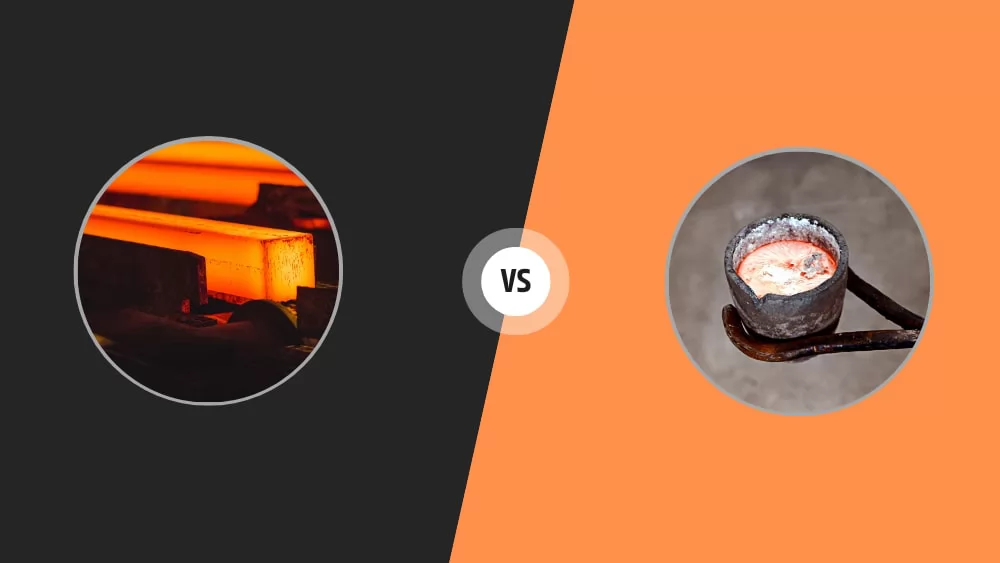
Have you ever stopped to think why some steel components are forged while others are cast, and what really sets them apart beyond the manufacturing names? Isn’t it true that the method used to shape steel can dramatically change its internal structure, strength, and performance?
In short, forged steel is shaped by hammering, pressing, or rolling heated solid steel billets, which aligns the grain structure along the contours of the part, giving it higher strength, toughness, and impact resistance. Because there are no cavities or weak points from molds, forged steel is ideal for high-stress applications like gears, shafts, and crankshafts. On the other hand, cast steel is made by pouring molten steel into a mold, allowing complex shapes to be created in one step, but resulting in a more random grain structure and potential porosity, which can reduce strength and fatigue resistance compared to forgings. Therefore, forged steel tends to outperform cast steel in load-bearing and dynamic applications, while cast steel wins in producing intricate, cost-effective parts that would be difficult or impossible to forge.
Differences Between Forged Steel and Cast Steel (Comparison Table)
| Comparison Item | Forged Steel | Cast Steel |
|---|---|---|
| Manufacturing Process | Shaped by hammering, pressing, or rolling heated solid steel billets, without melting and casting | Made by pouring molten steel into a mold, forming the part in one step |
| Internal Structure | Grain structure aligned along the contours, dense and free of pores, with continuous fiber flow lines | Random grain distribution, possible presence of shrinkage cavities, pores, and inclusions |
| Mechanical Properties | High strength, toughness, impact resistance, and good fatigue performance | Moderate strength, toughness varies with process, prone to stress concentration |
| Shape Complexity | Suitable for relatively simple geometries or those requiring multi-step machining | Capable of producing very complex shapes in a single step |
| Size and Weight Range | Suitable for small to large parts (limited by equipment capacity) | Can produce extremely large and heavy parts |
| Production Cost | High equipment investment, long process cycle, relatively high per-piece cost | High mold cost, but lower per-piece cost in mass production |
| Typical Applications | Gears, shafts, crankshafts, connecting rods, high-pressure valve parts, etc. | Complex casings, valve bodies, supports, marine components, architectural ornaments, etc. |
Detailed Explanation of the Differences
Difference 1. Manufacturing Process Differences
Forged Steel: Uses solid-state forming, where heated solid steel billets are shaped through mechanical forces such as hammering, pressing, or rolling. The process does not involve melting, so there are no casting defects. The metal is deformed plastically to achieve the desired shape and properties.
Cast Steel: Uses liquid-state forming, where molten steel is poured into a pre-made mold (sand mold or metal mold) and allowed to cool and solidify. This method can produce very complex shapes in a single step.
Difference 2. Internal Structure and Defects
Forged Steel: During forging, the metal grains are elongated and aligned along the contours of the part, forming continuous fiber flow lines. This eliminates internal pores and shrinkage defects, resulting in a denser material. Stress is distributed more evenly under load, reducing the likelihood of crack initiation.
Cast Steel: Due to solidification from the liquid state, defects such as shrinkage cavities, pores, and inclusions are more likely to form. The grain structure is randomly distributed, and localized areas may exhibit segregation or porosity, which can reduce fatigue strength and impact toughness.
Difference 3. Mechanical Property Differences
Forged Steel: Thanks to its dense structure and aligned grain flow, forged steel exhibits higher tensile strength, yield strength, fatigue life, and impact resistance. It is especially suitable for parts subjected to dynamic or repeated loads.
Cast Steel: Strength and toughness depend on casting process control and subsequent heat treatment. Generally, it is lower than that of forgings of the same material. Complex shapes can lead to stress concentrations, reducing overall reliability.
Difference 4. Shape Complexity and Machining
Forged Steel: Suitable for relatively simple shapes or those that can be further processed by machining. Extremely complex shapes are difficult or impossible to achieve in a single forging step and may require multiple processes and tooling.
Cast Steel: Can produce very complex geometries in a single step, including internal cavities, thin walls, and curved surfaces, reducing the need for extensive machining. This makes it ideal for parts with intricate designs.
Difference 5. Size and Weight Range
Forged Steel: Limited by the capacity of forging equipment, typically ranging from tens of kilograms to over ten tons for a single piece. Extremely large forgings require specialized equipment.
Cast Steel: Not limited by forging capacity, capable of producing single castings weighing dozens or even hundreds of tons, such as large ship propellers or hydro turbine casings.
Difference 6. Cost and Application Trade-offs
Forged Steel: Requires high upfront investment in tooling and equipment, making it suitable for high-performance, high-load parts produced in small to medium batches.
Cast Steel: While mold costs are high, casting is more economical for complex shapes produced in large quantities. It is often the preferred choice when part geometry is difficult or impossible to forge.
Summary
Forged steel excels in performance (strength, toughness, reliability), making it ideal for dynamic and high-stress applications. Cast steel, on the other hand, is superior in shape complexity and cost-effectiveness, making it the better choice for intricate parts that are difficult or uneconomical to forge. The choice between the two depends on the load conditions, shape complexity, and production volume of the part.
If you need custom steel castings for your project, please tell us your requirements. Our engineering team will provide you with advice and solutions free of charge.
Steel Casting Related Content Recommendations
- Top 10 Steel Casting Manufacturers in China by 2026
- China Metal Parts Casting Service: 2026 Procurement Guide
- Steel Casting Vs. Aluminum Casting: How to Choose?
- Why Everyone is Switching to Steel Castings: 4 Key Points
- Steel Casting or Iron Casting: Which Is More Suitable for You?
- 3 Different Types of Steel Castings & How to Choose?
- What Is Steel Casting? Process, Applications, And Prices


