
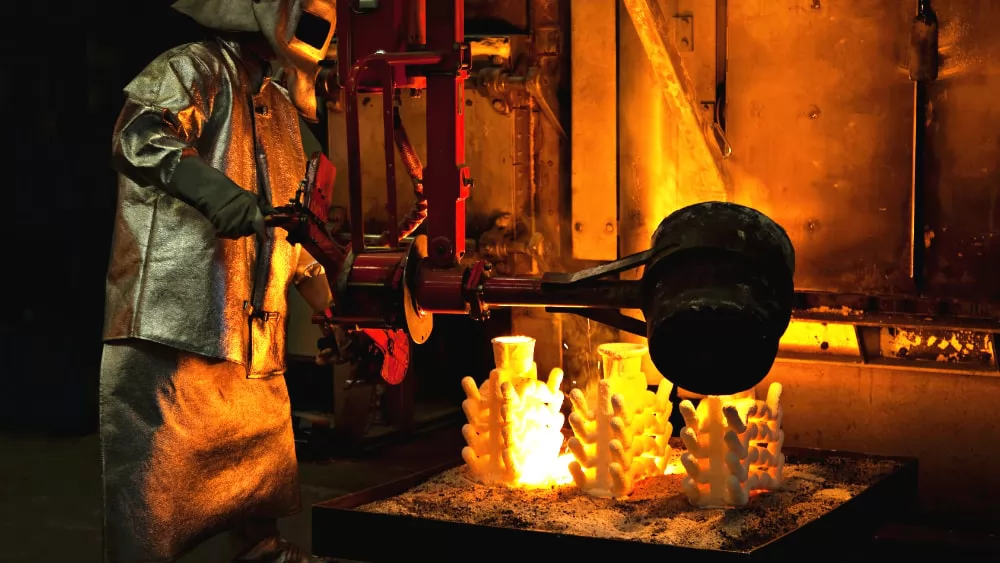
Yes, stainless steel can be cast—but it requires specific techniques and considerations due to its unique metallurgical properties. Here’s a breakdown of how, why, and the key factors involved:
1. Why Casting Stainless Steel Is Possible (But Challenging)
Stainless steel contains chromium (≥10.5%), which forms a passive oxide layer that resists corrosion. However, this same chromium makes casting more complex than with carbon steels:
- High melting point: Most stainless steels melt at ~1370–1530°C (2500–2800°F), higher than many common metals (e.g., aluminum melts at ~660°C). This demands specialized furnaces and molds that withstand extreme heat.
- Solidification behavior: Stainless steel solidifies with a tendency to form coarse grains or defects like porosity (trapped gas) or hot tears (cracks from uneven cooling). Controlling cooling rates and mold design is critical to avoid these issues.
- Chromium oxidation risk: At high temperatures, chromium can react with oxygen in the air or mold materials, forming brittle chromium carbides or oxides that weaken the final part. This requires protective atmospheres (e.g., inert gases) or specialized mold coatings.
2. Common Casting Methods for Stainless Steel
Several casting processes are used, each suited to different applications:
a. Sand Casting
- Process: Molten stainless steel is poured into a sand mold (made from silica sand bonded with clay or resin).
- Pros: Low cost, flexible for large or complex shapes (e.g., pump housings, valve bodies).
- Cons: Lower dimensional accuracy; surface finish may require machining. Common for heavy industrial parts.
b. Investment Casting (Lost-Wax Casting)
- Process: A wax pattern is coated with ceramic to form a mold, then melted out. Molten stainless steel is poured into the hollow ceramic mold.
- Pros: High precision, excellent surface finish, and ability to make intricate details (e.g., turbine blades, medical implants, jewelry).
- Cons: Higher cost; limited to smaller parts (typically <25 kg / 55 lbs).
c. Die Casting
- Note: Rarely used for stainless steel. Die casting uses high pressure to inject molten metal into a metal mold, but stainless steel’s high melting point and viscosity make it hard to flow into fine details without damaging the die. Aluminum and zinc are more common for die casting.
d. Centrifugal Casting
- Process: Molten stainless steel is poured into a rotating mold, using centrifugal force to distribute the metal evenly (ideal for cylindrical parts like pipes, rings, or bushings).
- Pros: Dense, defect-free structures in symmetric shapes. Used for pipes, sleeves, and engine components.
3. Key Considerations for Successful Stainless Steel Casting
Alloy selection: Different stainless steel grades (e.g., 304, 316, 17-4PH) have varying castability. Austenitic grades (304/316) are easier to cast than martensitic (410) or precipitation-hardening (17-4PH) grades, which may require heat treatment post-casting.
Mold material: Refractory materials (e.g., zirconia, alumina) are used in investment casting to resist high temperatures and prevent chemical reactions with the metal.
Heat treatment: Post-casting processes (e.g., annealing, solution treatment) relieve internal stresses, refine grain structure, and restore corrosion resistance (critical for austenitic grades, which can lose corrosion resistance if cooled too slowly).
4. Applications of Cast Stainless Steel
Cast stainless steel is widely used where corrosion resistance, strength, and complex shapes are needed:
- Industrial machinery (pump casings, valves, impellers).
- Aerospace components (turbine parts, brackets).
- Medical devices (surgical tools, implantable parts).
- Food processing equipment (mixers, tanks).
Conclusion
Stainless steel can be cast, but it demands expertise in metallurgy, mold design, and process control to overcome challenges like high melting points and solidification defects. The choice of casting method depends on part size, complexity, and application requirements.
Do you need custom stainless steel castings for your project? We are a professional manufacturer and supplier of steel castings, capable of providing high-quality steel casting products for your projects. If you have any needs, please contact us via email, and we will provide you with advice and a quote free of charge!
Related Steel Castings Article Recommendations:
- Differences Between Forged Steel and Cast Steel: 2026 Guide
- Top 10 Steel Casting Manufacturers in China by 2026
- Steel Casting Vs. Aluminum Casting: How to Choose?
- Why Everyone is Switching to Steel Castings: 4 Key Points
- The 5 Essential Steps of the Steel Casting Process (Simple Guide)
- Steel Casting or Iron Casting: Which Is More Suitable for You?
- 3 Different Types of Steel Castings & How to Choose?
- What Is Steel Casting? Process, Applications, And Prices


